
When Should You Run Functional Gut or Microbiome Testing for Your Pet?

Written by Dr. Katie Woodley, BVSc, cVMA, GDVCHM, CVNN
Last updated: August 6, 2026
The Quick Answer
Functional medicine testing for pets may be helpful when a dog or cat has recurring digestive or skin symptoms, improves only temporarily with supplements, has a history of repeated antibiotic use, or has completed an initial veterinary workup but important questions remain.
Functional gut tests and microbiome tests can provide information about intestinal inflammation, digestive function, immune activity, intestinal barrier markers, and bacterial imbalances. However, these tests do not diagnose every disease and should not replace veterinary examinations, bloodwork, urinalysis, parasite screening, imaging, or emergency care.
If you have a cabinet full of half-used probiotics, digestive enzymes, herbal formulas, powders, and supplements—but you still do not know what your pet actually needs—it may be time to stop guessing.
One of the questions I receive most often is:
“How do I know when it is time to run functional medicine testing on my dog or cat?”
Functional testing is not necessary for every pet or every symptom. But if you have been changing foods, rotating supplements, or seeing symptoms improve temporarily only to return again, testing may help you create a more focused plan.
At some point, we need to stop asking, “What supplement should I try next?” and start asking:
“What is actually out of balance in this individual pet?”
Key Takeaways
- Consider functional testing when symptoms keep returning or you are repeatedly changing foods and supplements without a clear plan.
- Functional gut tests and microbiome tests evaluate different aspects of intestinal health.
- No single abnormal marker automatically identifies the root cause of a pet’s symptoms.
- Routine veterinary diagnostics should come before—or be performed alongside—functional testing.
- Testing a healthy pet can provide baseline information, but annual functional testing is an individualized integrative approach rather than a universal veterinary requirement.
- Testing is most valuable when you know what question you want the results to answer.
In this article:
What Is Functional Medicine Testing for Pets?
Functional medicine testing for pets evaluates patterns related to how a body system is functioning. In this article, I am primarily referring to stool-based testing used to investigate different aspects of gastrointestinal health.
Depending on the panel, functional gut testing may evaluate markers associated with:
- Intestinal inflammation
- Digestive and pancreatic function
- Immune activity within the intestinal tract
- Intestinal barrier function
- Microbial activity
- Gut microbiome balance
These tests may add useful information to your pet’s health picture, but they are not intended to replace standard veterinary diagnostics.
Routine bloodwork gives us important information about blood cells, organ function, proteins, electrolytes, glucose, and other systemic changes. It does not directly measure every aspect of intestinal inflammation, local immune activity, intestinal barrier function, digestive capacity, or microbiome balance.
This means a pet can have bloodwork within the laboratory reference ranges and still experience legitimate digestive or skin symptoms.
That does not mean the bloodwork failed. It may mean that we need to investigate another part of the health picture.
The Most Important Question to Ask Before Testing
Before ordering any test, I ask:
“What decision could this result help us make?”
Testing should have a purpose. For example, are we trying to determine whether:
- Intestinal inflammation may be present?
- The immune system inside the gut appears underactive or overstimulated?
- The intestinal barrier may need support?
- Digestive function may be impaired?
- Antibiotics or chronic illness may have disrupted the microbiome?
- A targeted gut-support plan is creating measurable improvement?
- Your healthy pet’s internal patterns are changing over time?
If you do not know what question you are trying to answer—or what you might do differently based on the result—you may not be ready to test yet.
More data is not always better. The goal is to obtain information that can help you and your veterinarian make a more informed decision.
When Should You Consider Functional Medicine Testing for Your Pet?
Consider functional gut or microbiome testing when your pet has received an appropriate initial veterinary evaluation, but you still need more information to create a focused plan.
In my clinical experience, testing is most useful in the following situations.
1. You Are Stuck in “Supplement Roulette”
Supplement roulette happens when you try one probiotic, switch to a digestive enzyme, add an herbal formula, change the food, introduce more fiber, and then try another probiotic.
Something may help briefly, but the improvement does not last. Eventually, you are no longer sure:
- Which product is helping
- Whether a product is making symptoms worse
- Whether you used something long enough
- Whether multiple products are working against each other
- What problem each supplement was intended to address
This does not mean you have not tried hard enough. Most pet parents end up in this cycle because they care deeply about their pets and are desperately searching for the one thing that will finally help.
Unfortunately, a long list of supplements is not the same thing as a consistent plan.
When we do not understand the pattern we are trying to correct, even high-quality products can become expensive guesses. Purposeful testing may help us identify which area deserves attention first.
2. Your Pet’s Symptoms Keep Returning
Functional testing may be worth considering when your pet’s symptoms repeatedly improve and return.
Recurring symptoms might include:
- Diarrhea or consistently soft stool
- Constipation
- Frequent vomiting
- Reflux-like symptoms
- Lip licking, gulping, or repeated swallowing
- Gas or bloating
- Abdominal discomfort
- Chronic itching
- Recurring ear inflammation
- Changes in appetite
- Food sensitivities
- Difficulty maintaining weight
- Symptoms that return when a particular supplement is stopped
Temporary improvement still gives us useful information. But when the improvement never holds, we need to ask why.
Are we temporarily controlling the symptom without addressing an underlying driver?
Is inflammation still present?
Is the microbiome struggling to recover?
Is digestion impaired?
Is stress continually affecting gut function?
Testing will not answer every question, but it may help narrow the possibilities and create a more targeted next step.
3. Routine Veterinary Testing Has Not Explained the Full Picture
Bloodwork, urinalysis, parasite screening, imaging, and other conventional diagnostics are essential. They can identify serious diseases that should not be missed.
However, pets do not always fit neatly into one diagnostic box.
Sometimes a pet’s initial diagnostics are unremarkable, but the pet continues to experience recurring digestive, skin, appetite, or inflammatory symptoms.
Functional testing may provide another layer of information in these cases.
This does not mean functional testing is better than routine diagnostics. Each test evaluates a different part of the health picture, and the results are most useful when interpreted together.
4. Your Pet Improves but Then Reaches a Plateau
Some pets respond to an initial change in diet or supplement but eventually stop progressing.
The stool may be better but never consistently normal. The itching may decrease but continue to flare. Vomiting may happen less frequently but never completely resolve.
A plateau can suggest that one part of the pattern has improved while another factor remains unaddressed.
Testing may help identify whether there are remaining concerns involving inflammation, digestion, immune activity, intestinal barrier function, or microbiome balance.
It may also indicate that gut markers have improved, prompting you and your veterinarian to investigate another body system rather than endlessly adding more gut supplements.
5. Your Pet Has Received Repeated Courses of Antibiotics
Antibiotics can be medically necessary and lifesaving. They can also alter the gut microbiome.
Some pets recover without noticeable problems. Others experience lingering changes in stool quality, appetite, digestion, or food tolerance.
Microbiome testing may be helpful when chronic or recurring digestive symptoms begin after repeated antibiotic treatment.
The goal is not to label all antibiotics as harmful. The goal is to determine whether microbiome disruption may be one part of the pattern and whether targeted support produces measurable improvement.
6. You Want to Know Whether Your Pet’s Plan Is Working
Symptoms matter, but they do not always tell us the entire story.
A pet may appear better while an internal marker remains abnormal. In another pet, laboratory markers may improve before the family notices a significant outward change.
When a baseline test has already been performed, retesting may help determine whether a targeted plan is producing measurable progress.
Depending on the pet, test, and intervention, retesting may be considered after approximately three months. The timing should be based on what is being monitored and whether the result will influence the next step.
The goal is not to chase perfect numbers. It is to see a pet who feels better, functions better, and is moving in a healthier direction.
What Is the Difference Between a Functional Gut Test and a Microbiome Test?
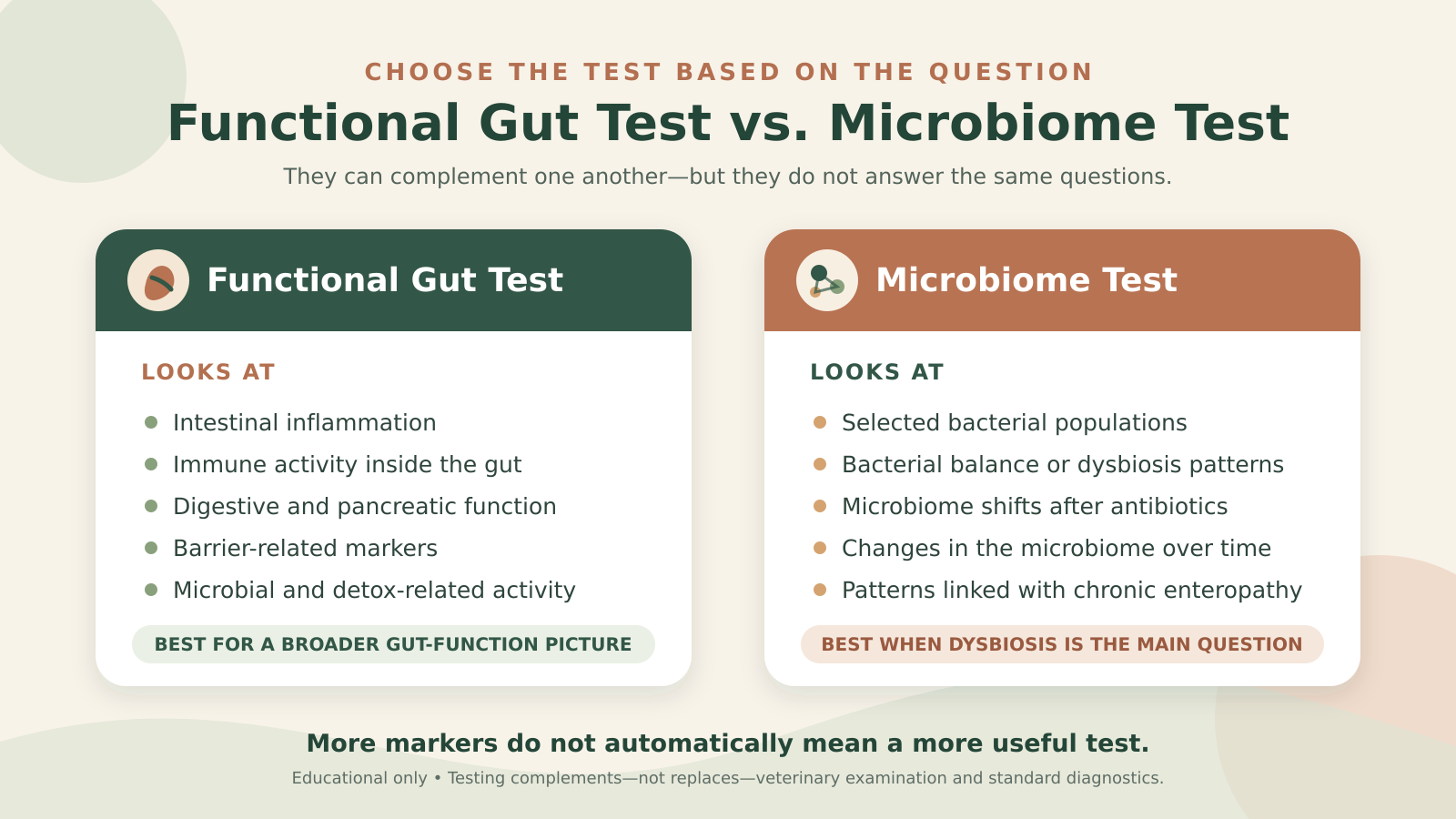
A functional gut test evaluates markers related to how the intestinal system is functioning. A microbiome test evaluates bacterial populations or patterns found in the stool.
The two tests may provide complementary information, but they do not answer exactly the same questions.
| Type of test | What it generally evaluates | When it may be helpful |
|---|---|---|
| Functional gut test | Inflammation, digestive function, intestinal immune activity, barrier-related markers, and microbial activity | Recurring digestive or skin symptoms, suspected inflammation, impaired digestion, or the need for a broader gut-function picture |
| Microbiome test | Selected bacterial populations, bacterial balance, or a calculated dysbiosis pattern | Chronic enteropathy, repeated antibiotic exposure, recurring diarrhea, or concern about microbiome disruption |
| Standard fecal or parasite test | Parasites, parasite eggs, and certain infectious organisms, depending on the test | Routine parasite screening, diarrhea, exposure risks, or suspected infection |
| Routine bloodwork and urinalysis | Blood cells, organ function, proteins, electrolytes, metabolic changes, and urine health | Preventive screening, systemic illness, medication monitoring, and the initial investigation of many symptoms |
Parasite tests can be run at your veterinary clinic. Innovative Pet Lab also offers at-home parasite testing.
Affordable Pet Labs is another option for in-home lab testing for pets that are nervous or have trouble getting to the veterinary clinic. Results can be shared with your veterinarian for interpretation.
One test is not inherently better than another. The right test depends on the question you are trying to answer.
What Does the Innovative Pet Lab Comprehensive Gut Check Measure?
The Innovative Pet Lab Comprehensive Gut Check is an at-home stool test that evaluates several markers associated with different aspects of intestinal function.
The canine panel currently includes:
- Calprotectin: A marker associated with intestinal inflammation. This marker can also be used to track if medication or supplements are helping to calm inflammation in the GI tract.
- Secretory IgA: Provides information about immune activity within the intestinal tract. If this value is high, it means the immune system is working harder due to food sensitivities or possibly parasites.
- Zonulin: Used as a marker related to intestinal barrier function. When elevated, it can help identify leaky gut.
- Anti-gliadin IgA: Provides information related to the intestinal immune response to gliadin. If elevated, all sources of gluten should be removed from the diet.
- Pancreatic elastase: Associated with pancreatic and digestive function. Higher values are important. A low level shows that pet is not properly digesting their food.
- Beta-glucuronidase: Provides information related to microbial activity and detoxification processes. Elevated levels can indicate an issue with detoxification and/or dysbiosis concerns.
These markers may help us consider whether the intestinal environment is inflamed, whether digestion may be compromised, whether local immune activity appears altered, or whether intestinal barrier support should be considered.
However, one elevated or low marker does not automatically diagnose your pet or explain every symptom.
A mildly abnormal result may not be the primary driver of a pet’s illness. Results need to be interpreted alongside:
- Symptoms
- Diet
- Medications
- Supplements
- Recent antibiotic use
- Medical history
- Routine diagnostic results
- Previous interventions
- Response to treatment
The overall pattern matters more than one red number on a report.
What Does a Pet Microbiome Test Measure?
A pet microbiome test evaluates bacterial populations found within a stool sample.
Depending on the test and methodology, a microbiome report may:
- Measure selected bacterial groups
- Calculate a dysbiosis score
- Identify patterns associated with chronic digestive disease
- Compare a pet’s sample with a reference population
- Monitor bacterial changes over time
Microbiome testing may be particularly helpful when there is concern about dysbiosis following repeated antibiotic use, chronic enteropathy, significant illness, or recurring digestive symptoms.
However, microbiome tests are not all the same.
Different laboratories may use different testing technologies, evaluate different organisms, and compare results with different reference databases. A report containing a long list of microorganisms may look comprehensive, but more information does not necessarily make the result more clinically useful.
For example, the Texas A&M Gastrointestinal Laboratory Dysbiosis Index uses quantitative PCR to measure specific bacterial groups associated with dysbiosis. Other commercial tests may use broader sequencing methods and generate a different type of report. We routinely use microbiome tests from AnimalBiome for dogs and cats.
Always find out what technology is being used, what has been validated in dogs or cats, and how the result could affect your pet’s plan.
Does an Abnormal Functional Test Result Identify the Root Cause?
An abnormal functional test result does not automatically identify the root cause of a pet’s symptoms.
A test provides data. That data still needs to be interpreted within the pet’s full clinical context.
An abnormal marker could be:
- Directly related to the symptoms
- One contributor among several
- A consequence of another disease process
- Influenced by diet, medications, supplements, stress, or recent illness
- A mild change that is not currently clinically significant
Root-cause work does not mean assuming that every flagged result requires a supplement.
It means asking how the finding fits into the pet’s larger pattern and whether addressing it is likely to improve the pet’s health.
Should Healthy Dogs and Cats Receive Functional Gut Testing?
Some apparently healthy pets may benefit from baseline functional testing, but annual functional testing is not a universal requirement.
Health is not a simple switch where a pet is either completely healthy or clearly sick. A visible symptom may be the point when we notice a change, but it may not be the moment when that internal change began.
For my own pets and some proactive pet families, I consider functional gut testing approximately once a year to establish a baseline and monitor trends.
This is my personal integrative approach. It does not replace routine wellness examinations, standard bloodwork, urinalysis, parasite screening, or other preventive care recommended by the pet’s veterinarian.
Whether proactive functional testing is appropriate depends on:
- The pet’s age
- Medical history
- Previous antibiotic or medication use
- Diet
- Stress
- Breed-related risks
- Previous digestive problems
- The family’s budget
- Whether the result would change the plan
The value of baseline testing often lies in the ability to compare results over time.
What is normal for this pet? Has a marker changed substantially? Is there a developing trend that deserves attention?
Baseline data can be helpful, but we should avoid treating every minor fluctuation in an otherwise thriving pet.
Trust Your Observations, but Test With Purpose
You live with your pet every day. You may notice subtle changes before anyone else does.
These might include:
- A slight change in stool consistency
- More lip licking
- New grass eating
- A change in appetite
- Less interest in playing
- A duller coat
- Increased restlessness
- Changes in sleep
- A pet who simply does not seem like themselves
You should not have to wait until your pet becomes severely ill for those observations to receive attention.
If you feel like something is wrong, do not dismiss that feeling.
However, “I think we need more information” is different from “we need to order every test available.”
Bring your observations to your veterinarian. Review what has already been evaluated. Identify the remaining gaps, and then choose the next test that is most likely to clarify your next decision.
Why I Do Not Love the “Wait Until It Gets Worse” Approach
Not every imbalance will automatically worsen, and not every abnormal result will eventually become a disease.
However, persistent symptoms should not be dismissed simply because they are not yet severe.
Waiting while changing five more foods and adding six new supplements can make the pattern even more difficult to understand.
When appropriate testing can provide useful information, it may allow us to take more focused action sooner. Early action may also be simpler than trying to unravel years of symptoms, medications, diet changes, and overlapping supplements later.
This is not about reacting fearfully to every minor change. It is about remaining curious, tracking patterns, and being willing to investigate when something still feels wrong.
When Should Functional Testing Not Be the First Step?
Functional testing should never delay urgent veterinary care.
Contact a veterinarian promptly if your dog or cat has:
- Repeated vomiting
- Blood in the stool
- Black or tarry stool
- Significant or unexplained weight loss
- A swollen or painful abdomen
- Severe lethargy or weakness
- Dehydration
- Collapse
- Difficulty breathing
- Repeated unproductive retching
- Refusal to eat, especially in a cat
An at-home stool test is not an emergency test.
Functional testing also should not be the first or only test when a pet has not received an appropriate medical evaluation for ongoing symptoms.
Before assuming that symptoms are caused by the microbiome or the intestinal barrier, your veterinarian may need to evaluate for parasites, pancreatitis, foreign material, endocrine disease, liver or kidney problems, infection, cancer, or other medical conditions.
Integrative medicine should broaden the clinical picture, not create tunnel vision around the gut.
How Should You Prepare Your Pet for Functional Gut Testing?
If your pet is stable and you have decided to test, collect the sample before changing several foods or supplements at once whenever possible.
This provides a clearer baseline.
Keep a record of your pet’s:
- Current food, treats, chews, and toppers
- Medications
- Supplements
- Recent antibiotic use
- Recent anesthesia
- Travel or boarding
- Significant stressful events
- Appetite changes
- Stool quality
- Vomiting or reflux-like symptoms
- Skin and ear symptoms
- Timing and frequency of flare-ups
Do not discontinue a prescribed medication simply to obtain a test sample unless your veterinarian specifically tells you to do so. Follow the laboratory’s collection and storage instructions carefully.
The history surrounding the result may be just as important as the number on the report.
The Test Is Not the Treatment Plan
Testing may provide direction, but the report does not replace a thoughtful, individualized plan.
Once the results arrive, ask:
- Which findings match the pet’s symptoms and history?
- What is the highest priority?
- What should be addressed first?
- What can wait?
- Are additional veterinary diagnostics needed?
- How will progress be measured?
- Would retesting change the next decision?
The goal is not to correct every flagged value as quickly as possible.
The goal is to understand the larger pattern, create a consistent plan, and give that plan enough time to work.
Frequently Asked Questions About Functional Medicine Testing for Pets
What is functional medicine testing for pets?
Functional medicine testing evaluates patterns related to how a body system is functioning. For gastrointestinal health, this may include stool markers associated with intestinal inflammation, digestive function, immune activity, intestinal barrier function, microbial activity, or microbiome balance.
When should I test my dog’s gut health?
Consider gut testing when your dog has recurring diarrhea, vomiting, reflux-like signs, food sensitivities, skin problems, repeated antibiotic exposure, or symptoms that improve temporarily and return. Your dog should also receive an appropriate veterinary evaluation to rule out conditions that require standard diagnostics or immediate treatment.
When should I test my cat’s gut health?
Functional gut testing may be considered when a cat has recurrent vomiting, diarrhea, constipation, changes in appetite, weight loss, food sensitivities, or unexplained inflammatory symptoms. Because cats can become seriously ill when they stop eating, appetite loss should be evaluated promptly rather than waiting for an at-home test.
Is a functional gut test the same as a microbiome test?
No. A functional gut test evaluates markers of intestinal function, including inflammation, digestion, immune activity, and intestinal barrier health. A microbiome test focuses specifically on bacterial populations and dysbiosis patterns in a stool sample.
Can a stool test diagnose leaky gut in a dog or cat?
No single stool marker should be used by itself to definitively diagnose intestinal hyperpermeability, commonly called “leaky gut.” Markers such as zonulin may provide information about intestinal barrier function, but results must be interpreted alongside symptoms, history, other testing, and veterinary evaluation.
Can functional testing diagnose inflammatory bowel disease?
Functional stool testing cannot independently diagnose inflammatory bowel disease or chronic inflammatory enteropathy. It may identify patterns associated with intestinal inflammation or dysfunction, but diagnosis may require bloodwork, imaging, diet trials, endoscopy, biopsy, or other tests recommended by a veterinarian.
Does my pet still need bloodwork if I do functional testing?
Yes. Functional testing does not replace routine bloodwork. Bloodwork evaluates blood cells, organ function, proteins, electrolytes, metabolic changes, and other systemic concerns that a functional stool test cannot assess.
Should I test my pet’s microbiome after antibiotics?
Microbiome testing may be useful when a pet develops persistent or recurring digestive symptoms after antibiotic treatment. Not every pet needs testing after antibiotics, especially if the pet feels well and has normal digestion. The result should be used only when it could guide a meaningful next step.
Are at-home pet gut tests accurate?
Accuracy depends on the marker, testing methodology, sample handling, laboratory quality, and the interpretation of the result. Some tests and bacterial targets have more veterinary validation than others. Ask what the test measures, how it was validated in dogs or cats, and what decisions the result can realistically support.
Should I stop my pet’s supplements before collecting a sample?
Do not stop prescribed medications or medically necessary supplements unless your veterinarian tells you to do so. When possible, avoid introducing several new products immediately before testing. Follow the laboratory’s preparation and collection instructions and record everything your pet is currently receiving.
How often should functional gut testing be repeated?
Retesting is often considered after approximately six months, depending on the marker, intervention, and pet’s clinical progress. A test should be repeated only when the result could help evaluate the current plan or guide the next decision.
Should healthy pets receive functional gut testing every year?
Annual functional gut testing can be used as an individualized integrative monitoring strategy, but it is not a universal requirement. Age, medical history, previous medications, digestive history, budget, and whether the result would change the plan should all be considered.
What is the best gut health test for a dog or cat?
There is no single best test for every pet. A functional gut panel may be more useful when the primary questions involve inflammation, digestion, immune activity, or intestinal barrier function. A microbiome test may be more useful when there is a specific concern about dysbiosis or repeated antibiotic exposure.
What should I do after receiving abnormal gut test results?
Do not immediately add a separate supplement for every flagged marker. Review the results alongside your pet’s history, symptoms, diet, medications, and standard veterinary diagnostics. Prioritize the findings most likely to be clinically relevant and develop a consistent plan to monitor progress.
Is It Time to Test Your Pet?
Functional gut or microbiome testing may be worth considering when:
- Your pet’s symptoms keep returning
- You are constantly changing foods or supplements without a clear strategy
- Your pet has received an appropriate initial evaluation, but important questions remain
- You need more information about inflammation, digestion, immune activity, intestinal barrier function, or microbiome balance
- You want objective data to monitor a targeted plan
- You want to establish a thoughtful baseline for an apparently healthy pet
Testing is not about searching for something to fear. It is about replacing confusion with better questions.
Your pet may not need another random product. You may need a clearer understanding of what their body needs, a consistent plan, and a way to evaluate whether that plan is working.
Ready to Take the Next Step?
If you want to learn more about the Innovative Pet Lab functional gut tests I use, you can use code NATURALPET25 to save 25%.
Explore Functional Gut Testing
If you feel overwhelmed and do not know where to begin, start with my free Digestive Reset Roadmap.
Sources and Further Reading
- Innovative Pet Lab: At-Home Gut Tests and Included Markers
- Texas A&M Gastrointestinal Laboratory: Canine and Feline Microbiota Dysbiosis Index
- Review: Analysis of the Gut Microbiome in Dogs and Cats
- AAHA/AAFP: Diagnostic Testing for Each Feline Life Stage
This information is for educational purposes only and is not intended to replace the advice of your own veterinarian. If you wish to apply ideas contained in thenaturalpetdoctor.com, you are taking full responsibility for your actions. Please consult your veterinarian for medical advice for your own pets. Dr. Katie Woodley cannot answer specific questions about your pet’s medical issues or make medical recommendations for your pet without first establishing a veterinarian-client-patient relationship. Links in the blog are typically affiliate links that let you help support us.

Welcome To Our Natural Pet Care Blog!
Stay connected with weekly holistic pet care tips and updates!

Get your Standard Process Supplements Here!

