
Is Raw Dog Food Safe? A Veterinarian Explains What To Look For
By Dr. Katie Woodley, BVSc, GDVCHM, cVMA, CVNN · Integrative Veterinarian · Last updated: 10/16/26
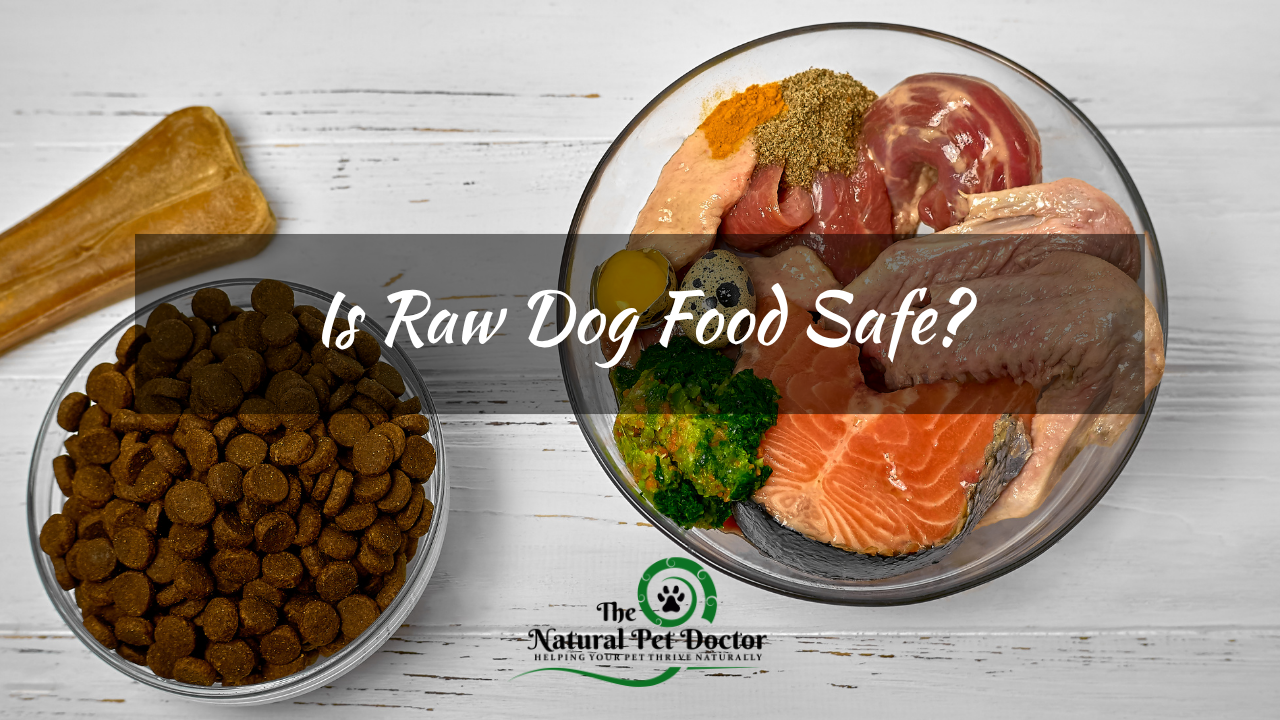
Yes. Raw dog food can be a safe, nutritious way to feed your dog when it’s properly formulated, made with validated food-safety steps, tested before release, and handled correctly at home.
The word “raw” on a bag won’t tell you any of that, though. You have to look at how the food was made.
Key Takeaways
- Raw feeding is safe when the whole system is in place: good sourcing, complete and balanced formulation, validated pathogen reduction, finished-product testing, and safe handling at home.
- Raw dog food can carry Salmonella, which is why reputable companies use processes like high-pressure processing (HPP) and batch testing to reduce that risk.
- HPP (cold pasteurization) uses water pressure instead of heat. A validated 5-log reduction lowers target bacteria by 99.999%.
- Raw chicken is safe as part of a balanced recipe, but plain raw chicken breast is an ingredient, not a complete meal.
- At home, treat raw dog food like the raw meat you cook for your family: keep it frozen, thaw it in the fridge, wash your hands, and clean bowls and surfaces.
I’ve been a veterinarian for more than 16 years, and I’m a strong supporter of raw feeding. I also want you to feed it with your eyes open.
So think of this article as your Raw Food Detective Guide. By the end, I want you to know what questions to ask about sourcing, formulation, HPP, testing, raw chicken, and safe handling.
Is Raw Food Good for Dogs? Why I Support Raw Feeding as a Vet
Dogs are built to digest and use animal protein and fat, and a properly formulated raw diet delivers those nutrients in a minimally processed form.
Here’s what a well-made raw diet gives your dog:
- High-quality animal protein and amino acids
- Nutrient-rich organ meats
- Essential fats
- Vitamins and minerals
- Natural moisture
- Nutrients that are sensitive to heat, kept closer to their natural state for better absorption
How do dogs digest raw meat?
Your dog’s stomach produces hydrochloric acid. That acidic environment activates pepsin, which starts breaking down protein.
In the small intestine, pancreatic enzymes take over. Proteases keep working on protein, lipase digests fat, and bile emulsifies fat so it can be absorbed.
Even their teeth tell the story. Canine and carnassial teeth are shaped for grasping, tearing, and shearing meat.
Dogs aren’t wolves, and they can digest carbohydrates. Genetic research shows domestic dogs developed adaptations for starch digestion that wolves lack (Axelsson et al., 2013).
They’re also extremely good at using animal protein and fat. That’s the foundation of why raw feeding works.
Does processing change dog food?
Yes. Heat, moisture, pressure, and cooking time all change the chemistry of food, and more intense processing tends to create more change.
Cooked food isn’t automatically unhealthy. But processing matters.
One example is advanced glycation end products (AGEs). These form during the Maillard reaction, when sugars react with proteins or fats under heat. Picture the brown crust on a seared steak.
In a study of healthy dogs, canned, dry, air-dried, and mildly cooked diets each led to different levels of AGEs in the food and in the dogs’ blood (Bridglalsingh et al., 2024).
So when I evaluate a food, I look at the ingredients and at what happened to those ingredients on the way to the bowl.
One more thing before we get to safety:
Raw doesn’t automatically mean balanced. A dog can digest a piece of raw meat perfectly well, and that piece of meat still won’t cover everything they need. Formulation matters as much as ingredient quality.
Does Raw Dog Food Contain Salmonella?
It can. Raw meat for dogs, like raw meat for people, may carry Salmonella, pathogenic E. coli, or Listeria. Good raw-food companies manage that risk with sourcing standards, validated pathogen reduction, and finished-product testing.
Dogs’ acidic stomachs are part of their natural defenses, but they aren’t immune to foodborne bacteria. Some dogs can also shed bacteria without showing signs of illness.
That’s why “does raw food contain bacteria?” is the wrong place to stop.
The better question is: What is this manufacturer doing to manage that risk?
What Makes Commercial Raw Dog Food Safe?
Commercial raw dog food is made safer by several layers of protection working together: responsible sourcing, a controlled manufacturing facility, a validated pathogen-reduction step such as HPP, and testing of the finished food before it ships.
No single step does the job alone. Here’s what to ask about each layer.
Where are the ingredients sourced?
Safety starts before the meat reaches the plant. Ask where the animal proteins come from and what standards suppliers have to meet. USDA-inspected sources are a good sign.
Where is the food made?
Look for transparency about the facility, sanitation, temperature control, and food-safety certifications. Certifications like SQF (Safe Quality Food) mean the facility is audited against a recognized food-safety standard.
What is HPP in raw dog food?
High-pressure processing (HPP), also called cold pasteurization, is a food-safety step that uses intense water pressure, instead of heat, to reduce harmful bacteria while keeping the food raw.
The sealed food goes into a chamber filled with cold water. The water transmits enormous pressure evenly around the package. That pressure disrupts the structures bacteria need to survive.
Research on commercial raw pet foods shows validated HPP can cut Salmonella and Shiga toxin-producing E. coli by 5 logs or more (Lee et al., 2023). Results depend on the recipe, the pressure and time used, and storage. Listeria was the hardest organism to reduce in that study, which is why validation and testing matter so much.
So when a company says “we use HPP,” ask one more question:
Has your HPP process been validated for your finished recipes?
What does a 5-log reduction mean?
A 5-log reduction means the process reduced the target bacteria by 99.999% under validated test conditions.
If you started with 100,000 bacteria, you’d have about 1 left.
That’s a big reduction. It isn’t sterilization, and it was never meant to work alone. Sourcing, sanitation, cold storage, packaging, testing, and your handling at home all still count.
Why does finished-product testing matter?
Batch testing checks that the safety system worked before the food leaves the facility.
Batch testing samples the finished food for pathogens before it’s released. Combined with good sourcing, a controlled facility, and validated HPP, it gives you several layers of protection stacked together.
That’s the standard I want you looking for.
Does HPP destroy protein or nutrients?
HPP doesn’t simply “destroy” nutrients. It can change some components, including protein structure and enzyme activity, but the amino acids stay intact, and many nutrients are better preserved than with intensive heat processing.
Changing a protein’s shape is called denaturation. Your dog’s own stomach acid does it. So do cooking, freezing, and fermentation.
What I care about more is whether that processing changes digestibility or nutrient availability, essentially how well your dog is absorbing the food.
Is HPP raw dog food more digestible?
Early research looks promising. In a 2026 study from the University of Illinois published in the Journal of Animal Science, researchers took a single batch of raw dog food and prepared it five ways: HPP raw, freeze-dried raw, sous vide, steamed, and retorted (the high-heat process used for canned and pouched food). Ten healthy adult Beagles each ate all five diets for 28 days at a time (Geary et al., 2026).
Here’s what they found:
- The HPP and steamed diets had higher dry-matter digestibility than the retorted, freeze-dried, and sous vide diets.
- Protein was less digestible in the retorted diet than in any of the other four.
- Fat was less digestible in the freeze-dried diet than in any of the other four.
- The HPP, steamed, and sous vide diets delivered more usable energy than the freeze-dried and retorted diets.
- Dogs eating the HPP and steamed diets produced less stool relative to how much they ate.
- The retorted diet led to more protein fermentation byproducts in the stool, such as ammonia and branched-chain fatty acids. That usually means more undigested protein is reaching the colon.
- Gut microbial diversity didn’t differ between diets, though some specific bacterial groups shifted.
It’s one study in ten dogs, and it doesn’t prove HPP makes every food more digestible. It does show that processing method influences how much of a food your dog actually uses.
What does a safe raw food system look like in practice?
This is a lot to research every time you buy food. That’s one reason many pet parents choose a commercial raw company that has already built these safeguards in.
We Feed Raw is a good example of what that system looks like. According to the company, it:
- Sources meat from USDA-inspected suppliers
- Makes its meals in an SQF Level 3-certified facility
- Uses HPP with a validated 5-log (99.999%) pathogen reduction
- Independently batch-tests its meals before release
Whatever brand you’re considering, ask it the same questions:
- Where do your ingredients come from?
- Who formulates your recipes?
- Where is the food made?
- What pathogen-reduction process do you use, and has it been validated?
- Do you test the finished food before it ships?
A company that answers those questions clearly tells you far more than the word “raw” on the package.
Is Raw Chicken Safe for Dogs?
Yes. Raw chicken is safe for dogs as part of a complete and balanced raw diet from a company with good food-safety practices. Plain raw chicken on its own is an ingredient, not a complete meal.
I get this question constantly, and it’s one of the most important distinctions in raw feeding.
| Plain raw chicken (e.g., a chicken breast) | Complete and balanced raw chicken recipe | |
|---|---|---|
| Protein and amino acids | Yes | Yes |
| Organ meat (vitamins A, B12, iron, copper) | No | Yes |
| Calcium from finely ground bone | No | Yes |
| Balanced calcium-to-phosphorus ratio | No | Yes |
| Essential fatty acids, trace minerals, vitamins | Incomplete | Formulated to meet standards |
| Complete enough to feed long term | No | Yes |
What does a dog need besides muscle meat?
- Muscle meat provides protein and amino acids.
- Organ meat supplies concentrated vitamins and minerals.
- Finely ground edible bone provides calcium and phosphorus.
On top of those, your dog needs the right amounts and ratios of essential fatty acids, vitamins, and trace minerals. Proportions matter. A diet that’s mostly muscle meat without a calcium source becomes imbalanced quickly, and too much of certain organs causes its own problems.
If you want to make raw food yourself, work with someone trained in canine nutrition. If you’d rather not do the math, a complete, balanced commercial raw recipe does it for you.
How Do You Safely Handle Raw Dog Food at Home?
Handle raw dog food the same way you handle raw meat for your own dinner. Keep it frozen, thaw it in the fridge, wash your hands, and clean bowls and surfaces after meals.
This part is simple:
- Store it frozen until you need it.
- Thaw it in the refrigerator, never on the counter.
- Wash your hands with soap and water after handling it.
- Wash your dog’s bowl after every raw meal. (I recommend this whatever your dog eats.)
- Clean counters, cutting boards, and utensils that touched the food.
- Pick up leftovers after the meal instead of leaving food out.
- Follow the manufacturer’s storage and thawing instructions.
If someone in your home is more vulnerable to foodborne illness, such as a baby or toddler, a pregnant family member, an older adult, or anyone who’s immunocompromised, be extra careful with handling and talk it through with your doctor and your vet.
I like to think of raw food safety as a shared job. The manufacturer handles sourcing, processing, sanitation, and testing. You handle storage, thawing, and hygiene once it’s in your kitchen.
Is Raw Dog Food Safer Than Kibble?
Neither one is automatically safer. Raw and kibble carry different risks, so judge the specific food: how it was formulated, made, tested, and stored.
| Raw dog food | Kibble | |
|---|---|---|
| Main safety focus | Managing bacteria in uncooked meat | Contamination after cooking, storage, fat oxidation |
| How pathogens are reduced | HPP or other validated non-heat steps, plus batch testing | High-heat extrusion |
| Effect of processing on nutrients | Minimal heat exposure | Higher-temperature processing can alter food chemistry, including AGE formation |
| Storage at home | Frozen, thawed in the fridge | Sealed, cool, dry; watch for rancid fats |
| What to check | Sourcing, validated HPP, batch testing | Ingredient quality, manufacturing controls, storage |
Raw food needs careful bacterial control because it isn’t cooked. That’s why sourcing, HPP, testing, and handling at home are important.
Kibble goes through high-heat processing that kills most bacteria during manufacturing. But it can still be contaminated after cooking, and fats can oxidize during storage. High heat also changes the food itself, which is where the AGE and digestibility research comes in.
So I’d swap “Is raw safer than kibble?” for this question:
How was this particular food formulated, made, tested, and stored, and how does my dog do on it?
What I Look for in a Commercial Raw Dog Food
I look for quality, responsibly sourced ingredients; complete and balanced recipes developed by qualified nutrition experts; validated food-safety processes; independent batch testing; and meals that are convenient enough to feed consistently.
These are the things I look for as a veterinarian.
1. Quality, responsibly sourced ingredients
Recognizable animal proteins, nutrient-rich organs, and a company that’s open about where its meat comes from.
2. Complete and balanced formulation
The food should be complete and balanced for your dog’s life stage. Ask who developed the recipes. You want qualified nutrition experts behind them, ideally a PhD animal nutritionist or board-certified veterinary nutritionist.
3. Validated food safety
A certified facility, a pathogen-reduction step like HPP that’s been validated for the finished recipes, and a company that can clearly explain all of it.
4. Independent batch testing
Each batch is tested for pathogens before it’s released.
5. Convenience and consistency
A beautifully formulated diet won’t help if it’s too hard to buy, prepare, or portion. Pre-portioned meals make it much easier to feed the same, balanced amount every day.
These are the criteria I use when I recommend a commercial raw food. WeFeedRaw is one of the companies I recommend because it checks these boxes: PhD-formulated, complete and balanced recipes, USDA-inspected meat, an SQF Level 3-certified facility, validated HPP, independent batch testing, and pre-portioned meals delivered to your door.
So, Is Raw Dog Food Safe?
Yes. A properly formulated raw diet is a safe, nutritious option for dogs when it’s responsibly sourced, made with validated food-safety controls, tested, stored correctly, and handled safely at home.
Raw being “good” or “bad” is the wrong frame. Ask this instead:
Is this particular raw diet properly formulated, responsibly made, tested, and right for my dog?
If you can answer that, you can feed raw with confidence. Then watch how your own dog does on it: their energy, coat, stools, and appetite will tell you a lot.
Try WeFeedRaw: 50% Off Your First Box
If you’d like to try a commercial raw food that meets the formulation and safety standards we’ve covered, take a look at WeFeedRaw.
They’re giving my community 50% off the first box of a new Meal Plan with code WOODLEY50.
Explore WeFeedRaw and get 50% off →
Whichever company you choose, keep this checklist handy.
Frequently Asked Questions About Raw Dog Food Safety
About the Author
Dr. Katie Woodley, BVSc, GDVCHM, cVMA, is an integrative veterinarian with more than 16 years of experience. She trained as a veterinarian in New Zealand, is certified in veterinary acupuncture, holds a Graduate Diploma in Chinese Herbal Medicine, and is certified in natural nutrition. She founded The Natural Pet Doctor and teaches veterinarians and pet parents how to use nutrition and integrative medicine to support lifelong health.
References
- Axelsson E, Ratnakumar A, Arendt ML, et al. The genomic signature of dog domestication reveals adaptation to a starch-rich diet. Nature. 2013;495:360–364. doi:10.1038/nature11837
- Bridglalsingh S, Archer-Hartmann S, Azadi P, et al. Association of four differently processed diets with plasma and urine advanced glycation end products and serum soluble receptor for advanced glycation end products concentration in healthy dogs. Journal of Animal Physiology and Animal Nutrition. 2024;108(3):735–751. doi:10.1111/jpn.13927
- Geary EL, Wang T-L, Vogel CL, Oba PM, Bauer LL, Dilger RN, Templeman JR, Danao M-GC, Swanson KS. Apparent total tract nutrient digestibility of frozen raw, freeze-dried raw, mildly cooked, and retorted dog foods and their effects on fecal characteristics, metabolites, and microbiota of healthy adult dogs. Journal of Animal Science. 2026;104:skag283. doi:10.1093/jas/skag283
- Lee A, Maks-Warren N, Aguilar V, et al. Inactivation of Salmonella, Shiga toxin-producing E. coli, and Listeria monocytogenes in raw diet pet foods using high-pressure processing. Journal of Food Protection. 2023;86(9):100124. doi:10.1016/j.jfp.2023.100124
- Wynn SG. Raw foods: a second look. Veterinary Clinics of North America: Small Animal Practice. 2025;55(6):1013–1034.
Disclaimer: This article is for general educational purposes only. It does not establish a veterinarian-client-patient relationship and is not a substitute for an examination, diagnosis, or individualized treatment plan from your pet's veterinarian. This article contains affiliate links. If you purchase through them, The Natural Pet Doctor may receive a commission at no additional cost to you.

Welcome To Our Natural Pet Care Blog!
Stay connected with weekly holistic pet care tips and updates!

Get your Standard Process Supplements Here!

